I am no longer blogging here at Little Nuances, but I would love for you to join me on my author website www.leewarren.info.

Friday, December 29, 2006

Passion

I've been thinking a lot lately about the things I enjoy. Why do I love tennis, baseball, and reading? I really can't say for sure, but I think it's because I saw how passionate other people were about them and how much those activities enriched their lives.

I started to love tennis after seeing how much John McEnroe cared about it. I started to love baseball after seeing how much my uncle loved to listen to the Kansas City Royals on the radio each night. And I started to love reading after a high school English teacher shared his love of books with us.

I've noticed the reverse to be true. I've interviewed athletes and I've witnessed the actions of athletes who lacked passion and it caused me to feel temporarily disillusioned. If they don't care, why should I? But then I catch myself and shake off their indifference because the last thing I want to live is a passionless life.

With that said, how much passion is too much? Can we get so engrossed in our passions that we fail to do the things we ought to be doing? Surely, the answer is yes, but at the same time, our passions, even if they seem menial to others, are important because they are the avenues we take to express ourselves.

In Nicholas Sparks latest novel, Dear John, the protagonist, John Tyree is bitter about the upbringing his father provided for him (who raised him by himself). John's dad was introverted, socially awkward, had no friends, and he rarely showed any emotion. His routines kept him going, but his passion was coin collecting. He'd inherited a huge collection from his father and all of his social ineptness melted away when he spoke about coins.

As a young boy, John enjoyed going to coin shows with his dad. And he had some great memories as they went on a search together for the illustrious 1926-D buffalo nickel. When they found it, John's dad had a coin dealer snap a photo of them with the coin. As John got older though, he began to resent his father's coin collection. It's all his father seemed to care about.

John later found out that his father had Asperger's. At that point, John knew that they only way to get into his dad's world was to talk about coins with him. And he began to realize that they really did have some great times growing up.

Passion for the things we enjoy not only benefits our own lives, but when we stop long enough to figure out other people's passions and then enter their worlds, we have a marvelous opportunity to interact with them in their most heightened sense of adventure.

Thursday, December 28, 2006

When God Steps In

One of the many aspects of writers' conferences that I enjoy is the one on one interaction. Sometimes it's an encouraging conversation between two writers who wouldn't have met any other way. Sometimes it's spending time with more seasoned writers who are willing to share their knowledge or pass along a bit of information. And sometimes it's helping another writer to learn how to better craft a story, book, or article.

At the Glorieta Christian Writers' Conference in November, I was one of twelve mentors for a class called "Get Published Now." The class is sponsored by CLASServices (who runs the conference) and Essence Publishing. Here's the premise--writers apply for the class, and if they are selected, they meet with mentors (two writers for every mentor) for four days to rework an article that the writer wrote before he or she came to the conference about a preselected theme. In this case, the topic was "true stories of transformation by God's grace."

I spent four days with two writers who were assigned to me and we covered the basics of good writing--showing instead of telling, active voice instead of passive voice, solid structure, believable dialogue, proper sentence structure, staying in the correct person, etc. By the end of the last class, both writers had a finished article which turned out to be a chapter in a book that was scheduled for release by Essence Publishing before Christmas called "When God Steps In." The book contains twenty-four such chapters.

I received a package the other day and as I ripped it open, I became as giddy by what I saw as I do when one of my own books arrives on my doorstep for the first time. It was a copy of "When God Steps In." I quickly turned to the two stories that I helped with and I read them both. I loved seeing how the stories came to life after both women implemented what they learned.

Oddly, the book isn't available on the Essence Bookstore website yet, but if you are interested in getting a copy, you could probably go to their Contact page and give them a call.

Wednesday, December 27, 2006

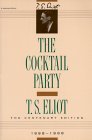
The Cocktail Party

Plays have never held much appeal for me--especially in written format. I've seen a couple of plays performed in community playhouses and I enjoyed them, but not enough to make it a regular habit. But I'm trying to branch out a little when it comes to the arts. Classic literature has never held a great appeal to me either, but I joined a literature group recently as part of my effort to grow in this area.

For our last meeting, we discussed The Cocktail Party, a play written in 1950 by T.S. Eliot. I found a copy at a public library and I was surprised by how much I enjoyed it. It's purported to be a "modern verse play about the search for meaning, in which a psychiatrist is the catalyst for the action." I was much more interested in listening to Edward (the host of the cocktail party) and his wife, Livonia, speak about who they were and who they weren't.

Edward and Livonia have been married for five years. They really couldn't say why the got married. They were attracted to each other, "well suited" for each other, and they eventually seemed to mistake such things for love. As the play opens, their marriage is in trouble. Edward has been shutting Livonia out in an apparent attempt to not go crazy and his indifference drove her to leave him temporarily.

By the end of the first act, they have it out--pointing to each others annoying habits. But that's just surface stuff. The real problems are much deeper. We eventually find out that Livonia feels like she is unlovable and Edward feels incapable of loving somebody.

Here's how Edward describes it:

"The one thing of which I am relatively certain
Is, that only since this morning
I have met myself as a middle-aged man
Beginning to know what it is to feel old.
That is the worst moment, when you feel that you have lost.
The desire for all that was most desirable,
And before you are contented with what you can desire;
Before you know what is left to be desired;
And you go on wishing that you could desire
What desire has left behind."

Lavinia eventually makes this statement: "It seems to me that what we have in common [her feeling unlovable and him feeling like he cannot love anybody] might be just enough to make us loathe one another."

But at the same time, it also is enough to make them realize that they can meet each other's need. And in spite of everything, they do.

I don't know that I'll be gobbling up more plays to read at my leisure any time soon, but I won't be so quick to discount them either.

Tuesday, December 26, 2006

Ray Blackston

Continuing with our Top Ten Series featuring my favorite authors:

#6: Ray Blackston

A few years ago, a friend handed me a novel and told me that I needed to read it. She's a member of my local writer's group that meets in a coffee shop once a month and we've gotten to know each other pretty well, so she knew I like movies and novels that are more character-driven than plot-driven and she knew that I enjoy love stories. The book she handed me was called Flabbergasted by Ray Blackston.

The novel is about a single man named Jay Jarvis who decides to go looking for love in Christian singles' groups. He meets some rather quirky people along the way and they eventually become good friends. But early on, Jay has his sights set on Allie. Problem is, she's already decided to become a missionary in Ecuador.

My friend was right about me needing to read this particular book. I devoured it and I thoroughly enjoyed reading a novel about the pursuit of love from a male protagonist's point of view. Helen Fielding started the chick-lit craze with her Bridget Jones's Diary series. Then along came books by Nick Hornby (About a Boy and Fever Pitch are just a couple of his titles), and Kyle Smith (of Love Monkey fame) in a new genre called lad-lit. Ray Blackston's Flabbergasted fit perfectly into this category.

Unfortunately, lad-lit was already on the down-trend by 2004 because men just don't buy these types of books. I'm the exception to the rule and I'm completely fine with that. But it does bum me out a little because poor sales means less contracts for such books in the future. But for now, I'm gobbling up all the books I can find in this genre and enjoying them.

Blackston wrote a sequel to Flabbergasted called A Delirious Summer about many of the same group of friends from the first book who decide to go to Ecuador to help rebuild huts after a fire. It's another great read about Christian singles who struggle to figure out their place in the world.

Blackston concluded the series with Lost in Rooville in which several of the same characters take a trip to Australia. Jay and his best friend Steve are planning to pop the question to their girlfriends and I just love the dialogue between them as the talk about how they are going to do it.

Jay becomes a new man as this series progresses after realizing that life takes on so much more meaning when a person lives to help other people. His struggle to find love was real. His struggle to become the type of man who is worthy of being married was real. His struggle to overcome his fear of leaving everything he knows behind is real. And I found myself challenged many times as I followed him on his journey.

Most recently, Blackston wrote a stand-alone novel called A Pagan's Nightmare and it looks hilarious. It's about a man named Larry Hutch, a novelist who isn't a Christian. He's witting a novel about a "reverse rapture" in which Christians are left behind--along with a few unbelievers. Given that Blackston is writing for a Christian audience, I admire his willingness to take a poke at one of our sacred cows.

I haven't had a chance to read this book yet, but I hope to soon. I picked up an advance copy at the International Christian Retail Show in Denver this past summer and I had a chance to meet and talk to Ray briefly while I was there. His first three books were with the same publishing house (Revell) that published my singles book, Single Servings.

I love many things about Blackston's books--his understanding of human nature, his understanding of the Christian singles seen, and his willingness to challenge the church on occasion. But most of all, I love the characters he creates. I actually feel like I know them and I suspect that any novelist would be happy to hear that.

Monday, December 25, 2006

Merry Christmas

"But you, O Bethlehem Ephrathah, who are too little to be among the clans of Judah, from you shall come forth for me one who is to be ruler in Israel, whose origin is from of old, from ancient days." --Micah 5:2, ESV

The One whose origin is from old has come to make all things new. He is Christ, the Lord. Merry Christmas!

Friday, December 22, 2006

A Christmas Carol

A couple of months ago, I decided that one of the ways I was going to enjoy Christmas this year was to read A Christmas Carol by Charles Dickens. I’ve never actually read the book. I saw the cartoon when I was little, but that hardly counts. As it turns out, the literature group I’m in decided to read and discuss the book for the month of December, so I read it this week.

As I was thinking about the various different themes in the book, I came across this passage after Scrooge has seen the light:

“He [Scrooge] went to church, and walked about the streets, and watched the people hurrying to and fro, and patted the children on the head, and questioned beggars, and looked down into the kitchens of houses, and up to the windows, and found that everything could yield him pleasure. He had never dreamed that any walk—that anything—could give him so much happiness.”

If Scrooge had taken that same walk before his perspective changed, he wouldn’t have went to church, or noticed people hurrying to and fro, or patted any children on the head, or cared about beggars, or found happiness in seeing others celebrate Christmas in their homes. His new attitude gave him compassion for his fellow man.

We don’t have to search far and wide to find real life examples of people in need. They are all around us this Christmas season. Some are lonely. Some are missing a spouse who passed away. Some are missing a parent. Some are recently divorced. Some are missing a soldier who is deployed. And some have made recent moves and are feeling desperately out of place.

Stay alert for such people this weekend. Listen to them. Laugh with them. Cry with them. Invite them to dinner. Meet their needs. It might just turn out to be the best Christmas you’ve ever had.

LinkWithin

Related Posts Plugin for WordPress, Blogger...